

Carolina Baker’s life changed in an instant in March 2022.
While turning across traffic on Route 105 in Sheldon, her car collided head-on with another vehicle, then spun and slammed into a telephone pole.“It was terrifying. The car was spinning and even though it probably only lasted a few seconds, it felt like forever,” Baker recalls. Baker remained conscious, but immediately knew something was wrong. She couldn’t put weight on her left foot. What she didn’t yet realize was that both of her ankles were broken.
An unusual, challenging injury
In sports injuries, falls or car accidents, force is typically absorbed unevenly. People tend to instinctively shift their weight or twist, so only one arm, leg or ankle takes the brunt of the impact. But in Baker’s case, both ankles were positioned and braced in a way that took the same force at the same moment.
“It’s unusual to have injuries on both sides of the body, and that alone makes recovery much more complicated,” says foot and ankle surgeon Dr. Kristin Kindred, who has treated Baker over the past few years. Baker underwent surgery on both ankles shortly after the crash. For nearly two months afterward, Baker couldn’t put weight on her ankles and relied on a wheelchair and a slide board to move around her house.
For someone who had always been independent, the sudden loss of mobility was challenging. “It was hard to need help for everything,” Baker says. “I had to learn patience, and I had to accept support.” Family, friends and members of her church stepped in to provide meals, care and companionship. Baker credits her support system and community with helping her through the most difficult stretches of her recovery.
Determination during a difficult recovery
For Baker, getting back on her feet has been challenging. She experienced post-operative complications on the more severely fractured right ankle, requiring additional procedures, hospital admission and weekly office visits.
“Despite these complications, Carolina was extremely compliant and positive in her recovery, and this helped her continue to move forward,” Dr. Kindred says.
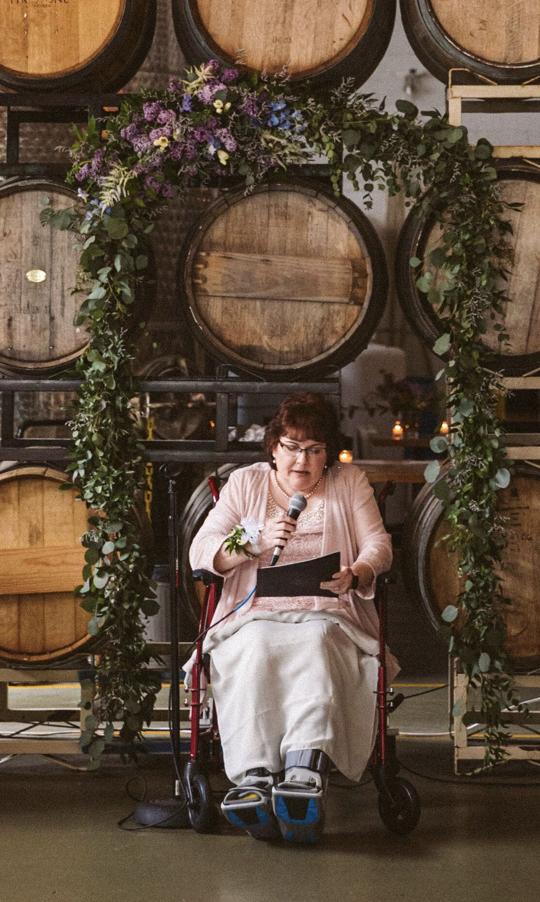
Baker was also determined to officiate her son’s 2022 wedding in the Pacific Northwest. While still in a wheelchair, recovering from an infection, and traveling cross-country with medical supplies, she made the trip to Oregon just seven weeks after the crash. She officiated the ceremony from her wheelchair, wearing the dress she bought long before the accident. “Missing my son’s wedding was not an option,” she says. “If there’s a will, there’s a way.”
Finding a solution
Baker’s right ankle quickly developed post-traumatic arthritis. And even after she was allowed to resume full activity months after the injury, she was limited. She lived with chronic pain for more than a year, walking with a cane and struggling to stay active.
The first six months after the car accident, Baker was mostly wheelchair bound. For the next 18 months, she walked with a cane and a limp. She avoided staying active to minimize her pain.
“I was always happy to see Carolina in my office, but I really wanted to see her thrive and walk with less pain,” Dr. Kindred says.
Dr. Kindred also tried steroid injections, hardware removal, ankle arthroscopy—a surgery using a tiny camera and tools—as well as lubricant injections and bracing. Despite these efforts, ankle fusion surgery became the best option to restore function and Baker’s quality of life. Ankle fusion surgery involves removing any remaining cartilage from the damaged ankle joint and compressing the ankle joint (tibia and talus) to grow together. Ankle fusion prevents painful motion at the damaged joint and the result is a stable, non-painful ankle, Dr. Kindred explains.
The surrounding mid- and hindfoot joints can compensate for the lack of ankle motion, allowing patients to return to most activities with proper footwear, she adds. Patients with isolated ankle fusions can expect to resume activities such as walking, hiking and even skiing.
“I often prefer ankle replacement in patients with post-traumatic arthritis, but because of Carolina’s post-op complications, she was not a candidate for replacement,” Dr. Kindred says. “Despite requiring fusion over replacement, I knew that the fusion procedure would give her less pain and more overall mobility.”
Baker admits she was hesitant about the procedure at first. The idea of another major surgery and long recovery felt daunting. “I didn’t rush into it,” Baker says. “I had already been through so much, and the idea of another surgery was scary. But I knew I couldn’t keep living in pain.” She trusted her care team and moved forward with the surgery in July 2024. She successfully healed from the surgery and completed her post-op rehab with her same positive mindset.
A second chance
Nearly four years after the accident, Baker now walks independently and has returned to many of the activities she loves, including walking, hiking and traveling.
“Compared to when I met her in a wheelchair with two injured legs, she is a completely changed person,” Dr. Kindred says. “She is now able to walk without a limp or any assistive devices. It’s incredible to see where she is today.” Baker’s experience has also reshaped how she sees others. When she sees people in the community with mobility challenges, Baker goes out of her way to connect with them, drawing on her own experience in a wheelchair. “You don’t know what someone’s going through when they are wheelchair bound,” she says. “But I do now.”
Dr. Kindred points out that Baker’s optimistic mindset played a significant role in her recovery. “She never stopped showing up,” she says. “She was persistent, positive and deeply appreciative. For such a difficult situation, she met every challenge with perseverance.” Baker describes her recovery as a second chance, and she’s determined to make the most of her health and mobility.
“I don’t look at things the same way anymore,” Baker says. “I’m just grateful to be here, grateful to be moving, and I don’t want to waste that.”